Programming
Individual Soccer Training Program: Evidence-Based Guide
Evidence-based framework for individual soccer training programs — self-directed or coach-guided. Needs analysis, periodisation, tracking, when to hire a coach.

Mario Jovanovic
S&C coach · 14 min read

Individual Soccer Training Program: Evidence-Based Guide
Most players think an individual soccer training program means extra cone drills from Instagram. Real individual work is a structured, periodised strength and conditioning plan built around your position, match minutes, injury history, gym access, and the club week you do not control — then adjusted from what you actually logged. This guide covers how to get that: self-directed, coach-guided remote, or hybrid — and how to tell the difference between a useful plan and a PDF that goes stale in week three.
If you want the research case for why squad S&C is not enough, start with why soccer players need individual training. This post is the how for players (and the coaches who serve them).
What “Individual” Actually Means (And What It Does Not)
Individual is not “fifteen unrelated programmes.” It is one shared skeleton with forced forks per athlete: minutes, position finish, injury dose, club load. Position averages are a start — Altmann and colleagues found that when professionals switched roles, only about 44–58% of the change in match output tracked positional norms; the rest stayed with the player (PLOS One). Ammann’s microcycle work makes the same point week to week: load diverges by player inside one squad (PLOS One).
So an individual soccer training program answers four questions every week:
- What did the club already train (and how hard)?
- What quality is still missing — force, eccentric control, high-speed, landing?
- Where does that quality fit on an MD-minus calendar?
- What did last week’s wellness and RPE say about readiness?
Without those forks, “personalised” is marketing. With them, one template can serve a starter, a unused sub, and a rehabbing wide player in the same club week. For the congested-week version of that split, see individual training for congested fixtures.
Three Ways to Get an Individual Program
Not every player needs the same level of support. Match the tier to budget, literacy, and how much accountability you actually use.
| Tier | Who it fits | What you get | Main failure mode |
|---|---|---|---|
| 1. Self-directed | Motivated player, some S&C literacy, limited budget | Needs analysis → MD-minus skeleton → tracking → rewrite every 8–12 weeks | Progression stalls; no one cuts the session when club load spiked |
| 2. Remote coached | Player who wants eyes on the week, trains anywhere | Intake + periodised plan + weekly adjustment from logs/video | Buying a static PDF and calling it coaching |
| 3. Hybrid | Near a coach, wants hands-on technique + remote week | Quarterly testing / technique in person; daily plan remote | In-person sessions that ignore club load the other five days |
Remote can work when it is coached, not just delivered. Online S&C with feedback loops has held stimulus in youth and academy settings (session RPE comparable to gym work in girls’ football during lockdown; remote Nordic/SLRDL protocols with full adherence in a small randomised trial). The constant across useful remote setups: the coach sees what was done and how it felt, then changes next week. A PDF cannot do that. King’s distinction — remote programming vs remote coaching — still holds; we used it in the international window piece.
Tier 1: Build a Self-Directed Plan Without Guessing
Needs analysis first (one page)
| Field | Why it changes the plan |
|---|---|
| Position | Sets the finish, not the whole sport |
| Last 5 match minutes | Starter vs unused sub = different MD+1 / next gym week |
| Injury history (12 mo) | Nordic/adductor dose and pain rules |
| Equipment | Trap bar vs bands changes the menu, not the goal |
| Club days + match day | Places gym on MD-minus, not “Monday” |
| Goals (ranked) | Availability usually beats vanity lifts |
Slot gym between club sessions — do not stack
Capture club work the same day: duration, RPE 1–10, label. Session load = RPE × minutes. Then map everything onto MD-minus and decide keep / cut / move / skip. The full decision table lives in programming around club training; the short version for self-directed players:
- Club SSG ≥70 min at RPE 7+ → no extra COD or dense lower circuits that day
- Club already did high-speed → do not add flying sprints
- Sleep ≤2/5 or hamstring irritable → drop eccentrics; isometrics or skip
- Two matches in seven days → activation only; protect both matches
In-season default: one or two gym sessions. Prefer MD-3 (or MD-4 if that is the open window) for heavy work; MD-2 for low-volume power/speed only if the club did not already own that quality; MD-1 activation only — no sneaky Nordics.
Shared skeleton + one position finish
Keep the big rocks every week: hinge or squat pattern, single-leg strength, calf/foot, trunk, hamstring eccentric, landing. Then pick one 8–12 minute finish by role (centre-back landings/short accelerations; wide players brake + short runs; midfielders often stop after the main lifts; forwards sprint or jump depending on whether they are the runner or the target; goalkeepers lateral bounds + horizontal press). Do not stack every finish on one sheet.
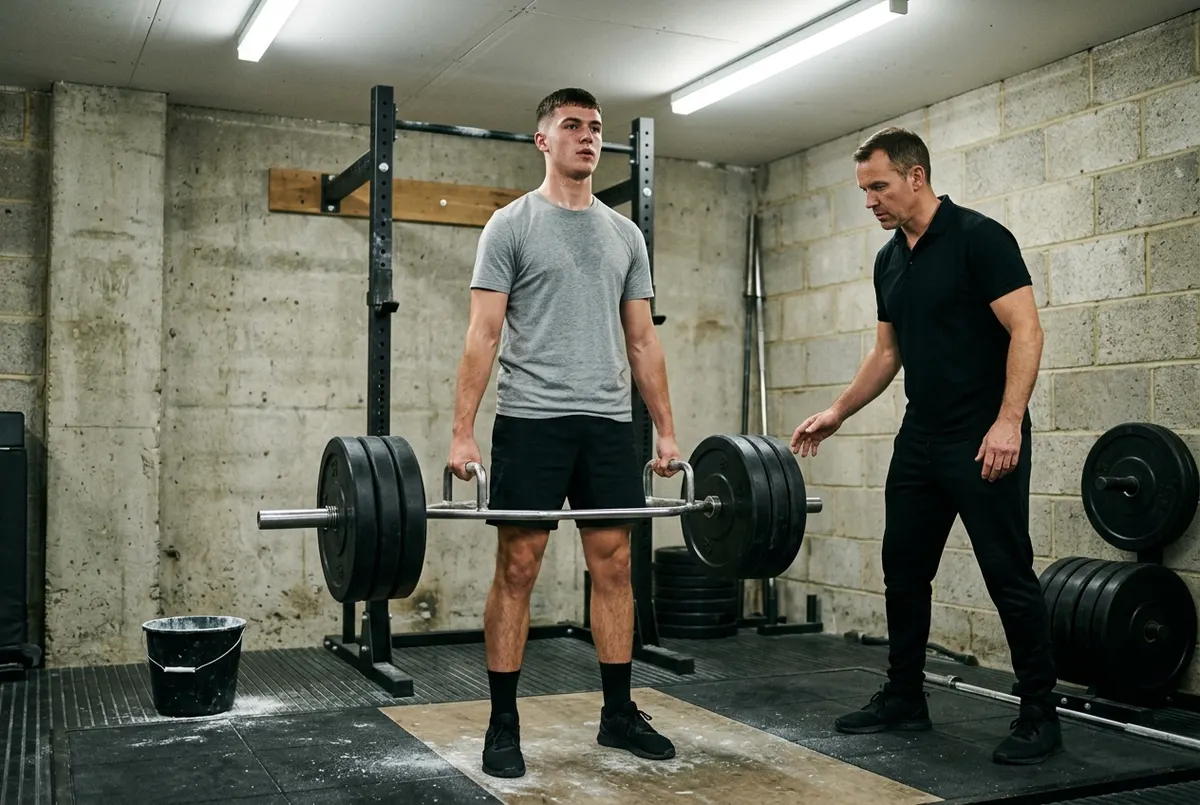
Progression for self-directed players: add load when the top set stays ≤RPE 8 with clean reps for two weeks; cut a set when club load was already high; rewrite the block every 8–12 weeks after a simple re-test (CMJ, 10 m, Nordic quality or SLHB). Periodisation here means changing the target of the block (accumulate → intensify → realise), not rotating exercises for novelty — a constant stimulus fades; periods need different content.
Tier 2: What Remote Coaching Should Look Like
You are paying for analysis → prescription → monitoring → adjustment, not for a prettier spreadsheet.
Working model (how MJ Perform runs it):
- Intake — history, schedule, equipment, goals; testing where possible (speed, jump, strength markers)
- Programme — MD-minus anchored, position-aware, built around club days and kit you actually have
- Daily / post-session — wellness + sRPE + club session log; optional form video
- Weekly review — coach reads the week, changes volume/exercise/skips, tells you why
- Block end — re-test and rewrite; do not run the same four weeks forever
Red flags (walk away):
- No intake before the first programme lands
- Monthly PDF with no check-in
- Never asks what the club did
- No wellness or RPE habit
- No testing window
- No direct channel when something feels wrong
For players: Mario Jovanovic runs MJ Perform — remote and in-person S&C for footballers, delivered on PlayerPlan. If you want a plan built around your club week, book a free call or see the MJ Perform coach profile.
Tier 3: Hybrid Without Doubling Fatigue
Hybrid fails when the in-person day is a second full programme on top of a hard club week. Use face-to-face time for technique, testing, and the lifts that need eyes. Keep the remote week for MD-minus placement, load cuts, and accountability. Same decision rules as Tier 1; more bandwidth for coaching cues.
Case Study Pattern: Academy Midfielder, No Club S&C
Profile (composite): 18-year-old central midfielder, 60–75 minutes most Saturdays, no recent hamstring history, school gym (rack + dumbbells), club Tue/Thu, match Sat. Club already covers most aerobic work. Gaps: heavy force, eccentric hamstrings, short acceleration.
12-week in-season shape (illustrative, not a promise):
| Phase | Weeks | Focus | Example gym week |
|---|---|---|---|
| Accumulation | 1–4 | Build quality volume | MD-3: trap-bar or squat pattern 3×5 @ RPE 6–7.5; split squat; Nordics 2×4 → 3×5; MD-1 activation |
| Intensification | 5–8 | Raise intensity, cut junk | MD-3 heavy 4×3 @ RPE ~8.5; MD-2 low-volume jumps + 10 m accelerations only if Thursday club was light |
| Realisation | 9–12 | Express, stay available | MD-3 low-volume heavy 3×2; skip extra speed if fixtures tighten |
What “good” looks like to track (not guaranteed outcomes): higher CMJ and cleaner 10 m over a block, more quality Nordic reps at the same RPE, zero soft-tissue time-loss, and match availability that matches the squad’s plan. If wellness and club load are not logged, you cannot explain any of those numbers.
How PlayerPlan Runs an Individual Soccer Training Program
Spreadsheets can store a plan. They cannot close the loop: player opens today’s session → logs what the club did → checks in wellness → coach sees gym + club load on one player page → next MD-3 is cut or kept. That loop is what PlayerPlan was built for. Here is the product path that matches the tiers above — not a feature dump, the minimum workflow an individual program needs.
1. One link per player (no app, no login)
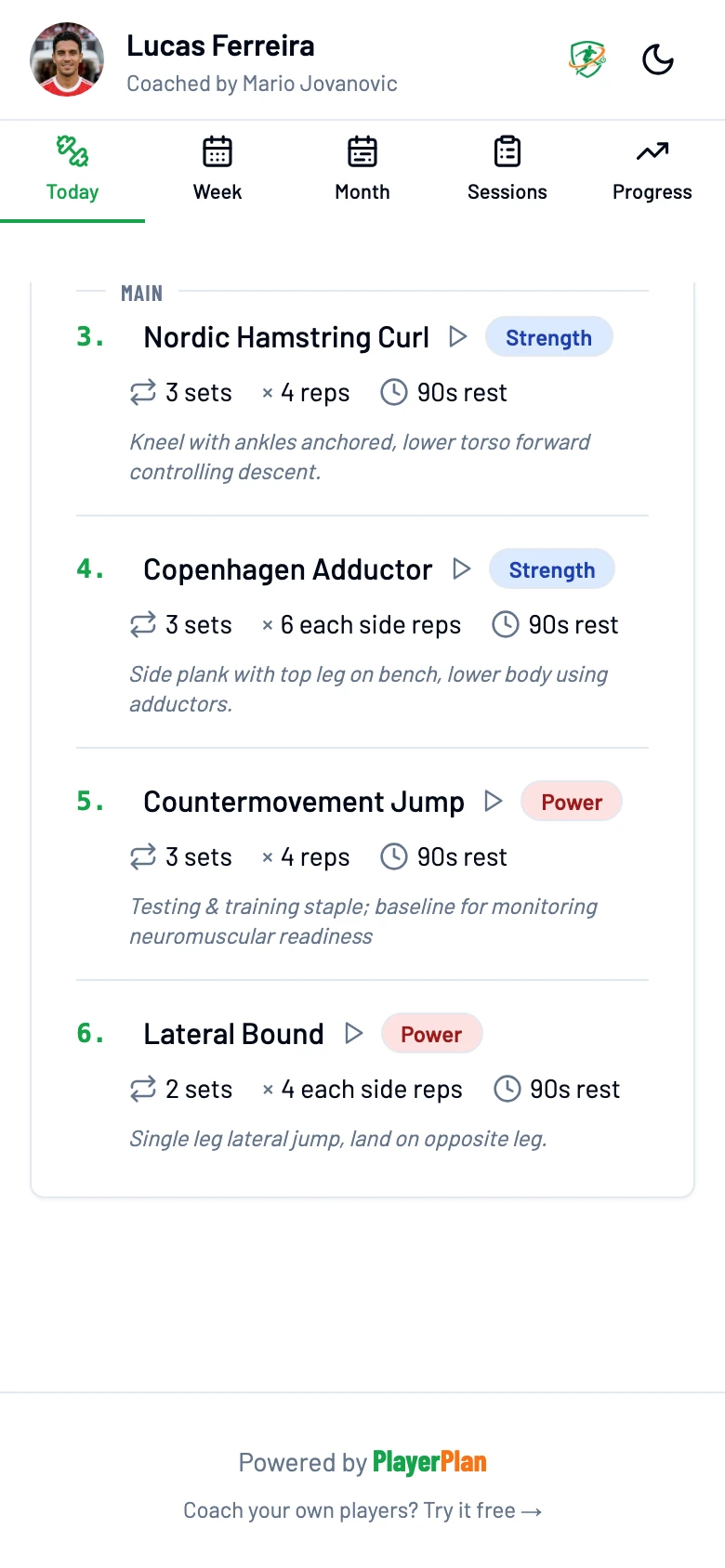
Each athlete gets a short share URL (/player/…). They open it on their phone. Today’s gym session is there with video demos, sets, reps, rest, and tempo. History and the upcoming week sit on the same link. No App Store step, no “I forgot my password” text. That matters for academy and remote players who will not install a seventh training app.
2. Club load lives on the same week as your gym work
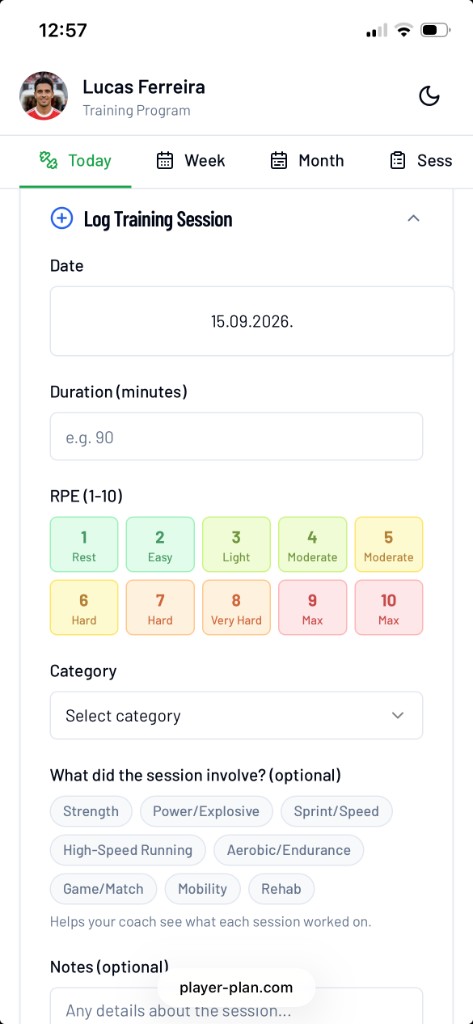
Independent coaches lose individualisation when club nights are invisible. On the share link the player logs date, duration (minutes), RPE 1–10, category (club training / SSG / gym / match / extra), and notes (“4v4 pressing,” “kept for finishing”). Session load is duration × RPE. That external load folds into the same player monitoring view as your prescribed sessions — so ACWR and weekly totals are not “gym only.”
3. Wellness before you guess readiness
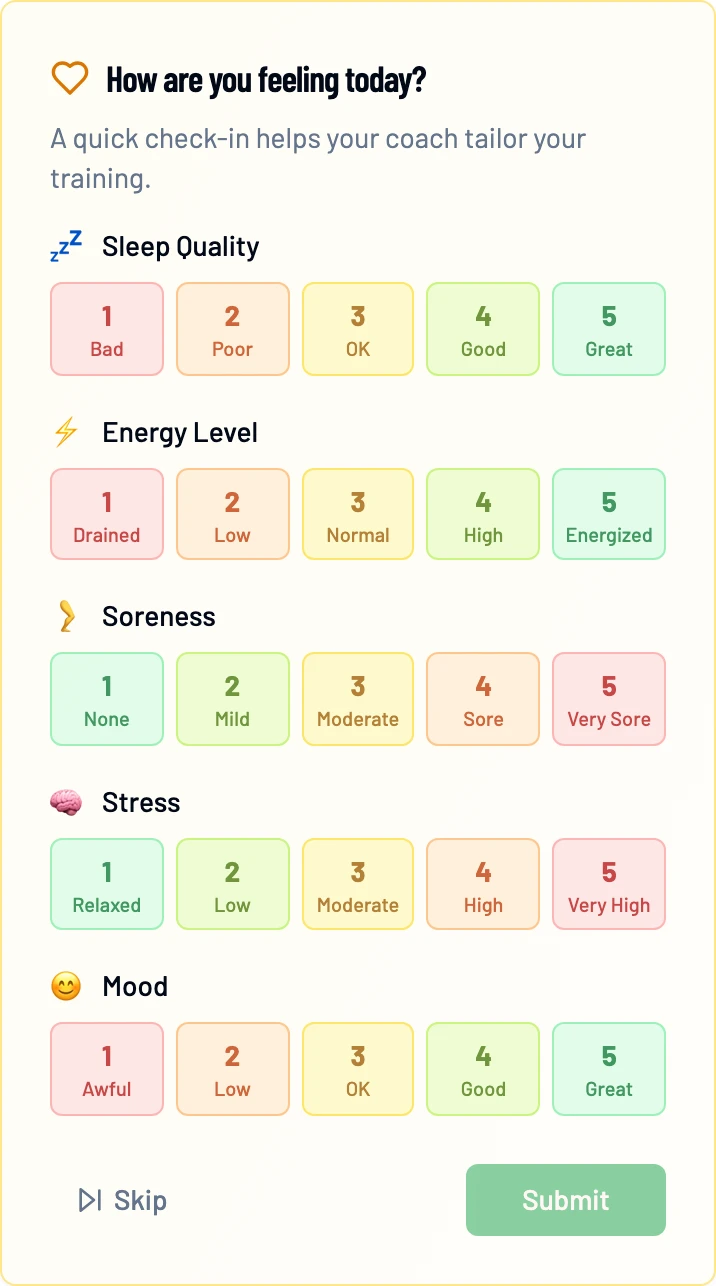
The check-in is five scores on a 1–5 scale: sleep quality, energy, soreness, stress, mood. Soreness and stress invert (higher = worse). It takes about 30 seconds. A sleep of 2 with high soreness the morning after a midweek cup is a cut/skip signal for eccentrics — the decision rules from Tier 1, with data instead of vibes.
4. Coach side: template once, fork per athlete
On the coach dashboard you build the shared skeleton in the session builder (blocks, supersets, 800+ exercises with video). The program designer holds the multi-week block with phase labels (Base / Build / Peak / Taper / In-Season / Off-Season), volume targets, and intensity zones — so accumulation → intensification → realisation is visible as a calendar, not a chat thread. Duplicate a session for the unused sub’s high-speed top-up without rewriting the starter’s deload. Drag when fixtures move; the player’s link updates.
Player page load monitoring stacks your gym session load + their logged club sessions. Sunday review is “what did this athlete actually live?” — not “what did I paste into WhatsApp on Monday.”
5. Optional AI that already speaks MD-minus
Trial and Pro include an AI assistant trained on football S&C context (periodisation, position, ACWR language). Useful for a first draft of an MD-3 or an exercise swap when a groin is irritable — then you still own the keep/cut/skip call from the logged week. It does not replace the coach; it speeds the fork.
Soft vs hard individualisation on the platform
| Job | What you do in PlayerPlan |
|---|---|
| Shared template | One program phase; clone sessions across the roster |
| Per-player fork | Edit one athlete’s MD-3 sets / swap Nordic dose / skip speed |
| Club visibility | Player logs external load on the share link |
| Readiness | Wellness check-ins on the same link |
| Delivery | Short token URL — no install |
| Review | Player page: gym load + club load + wellness trend |
That is the difference between “send a PDF” and “run an individual soccer training program.” MJ Perform’s remote athletes use this loop; independent coaches use the same stack for their own roster.
Want that loop without building it in Notion? PlayerPlan’s session builder, program designer, share links, wellness, and club-load logging are built for football’s match week. Try it free for 30 days →
Implementation Checklist
- One-page needs analysis (position, minutes, injuries, kit, schedule, ranked goals)
- Club sessions logged same day (duration × RPE + label)
- Gym placed on MD-minus; keep / cut / move / skip rules written down
- Shared skeleton + one position finish (not five finishes)
- Monthly simple tests; rewrite every 8–12 weeks
- If paying a coach: intake, weekly adjustment, club-load questions — or it is a PDF
FAQ
Can I write my own individual soccer training program with no S&C background?
You can start with Tier 1: needs analysis, MD-minus placement, one finish, and honest logging. Progression and when to skip is where most self-directed plans fail — plan to get coaching eyes on it within a few months if the goal is serious.
Do I still need individual work if my club has an S&C coach?
Often yes. Club S&C is still a group average. Starters need recovery management; unused players need high-speed and intensity they did not get in the match. Individual work fills your gap, not a second full programme.
How many gym sessions per week in-season?
Usually one or two. More often means interference with club training. See in-season training for dose.
What if I only have a park and bands?
You can still train force and eccentrics: partner Nordics, single-leg RDL, Copenhagen, split squat, broad jump, short hill sprints. Equipment changes the menu; it does not remove the need for a calendar.
When should I hire a remote S&C coach?
When you are stuck, coming back from injury, cannot stay consistent, or want the weekly adjustment without guessing. Book a call if you want that done for you rather than DIY.
References
- Altmann et al. (2021). Match physical performance: position or player specific? PLOS One. https://journals.plos.org/plosone/article?id=10.1371/journal.pone.0256695
- Ammann et al. (2023). Individual variation in professional soccer microcycles. PLOS One. https://journals.plos.org/plosone/article?id=10.1371/journal.pone.0286372
- Suarez-Arrones et al. (2020). Individual load variation and match participation. Frontiers in Sports and Active Living. https://www.frontiersin.org/journals/sports-and-active-living/articles/10.3389/fspor.2020.00075/full
- Drayton, Hamad & Spyrou (2025). The time course of postmatch physical impairments in professional soccer: a systematic review. J Strength Cond Res. doi:10.1519/jsc.0000000000005252
- Clemente et al. (2024). Balancing the load: compensatory training strategies for non-starting soccer players. Biol Sport. doi:10.5114/biolsport.2024.139071
- Rago et al. (2025). Accumulated training load between football players exposed to different playing times: a systematic review. Int J Sports Sci Coach. doi:10.1177/17479541251315667
- Weldon et al. (2021). Contemporary practices of S&C coaches in professional soccer. Biology of Sport. https://pmc.ncbi.nlm.nih.gov/articles/PMC8329977/
- McLain et al. (2024). Locked down but not out: on-line strength and conditioning provides a viable stimulus for girls’ football players. Int J Strength Cond. https://journal.iusca.org/index.php/Journal/article/view/401
- Ripley et al. (2024). Implementing hamstring injury prevention programmes remotely: a randomised proof of concept trial. BMJ Open Sport Exerc Med. https://bmjopensem.bmj.com/content/10/1/e001728
For players: get a plan built around your club week with MJ Perform — book a free call or visit /coach/mjperform.
For coaches: PlayerPlan gives you the session builder, multi-week program designer, one-link player sharing, wellness and club-load logging so each athlete’s individual soccer training program stays tied to the week they lived. Start a 30-day trial at player-plan.com (full Pro features, 3 players).*
Ready to ditch the spreadsheets?
Session building, periodization, load monitoring and no-login player sharing — built for football S&C coaches.
Start your free 30-day trialPro features, AI included. No credit card.